

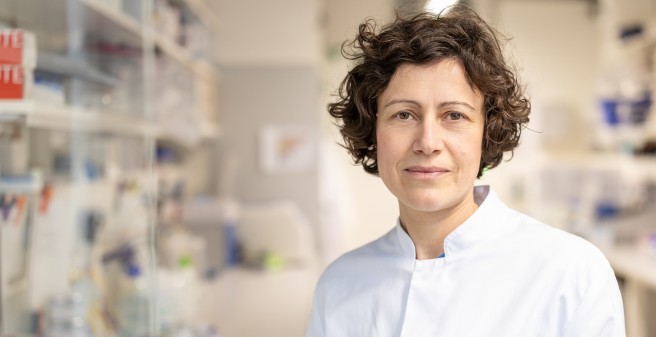


Globetrotter from Southern Italy
Prof. Dr. Lidia Bosurgi has had a globe-trotting career in science. After completing her studies in Milan, she went on to Harvard University in Boston and Yale University in New Haven, before finally settling at the University Medical Center Hamburg-Eppendorf (UKE) in 2017. There, she and her team have studied how specialized immune cells, called macrophages, can be programmed to repair damaged tissue.
Text: Nicole Sénégas-Wulf, Photos: Axel Kirchhof
Lidia Bosurgi originally wanted to become an archaeologist. If it hadn’t been for her high school biology teacher, who sparked her interest in the natural sciences and medicine. “Even though my father was a physician, it was hard for me to imagine myself in that profession because I’m not particularly fond of seeing blood and worry about becoming overly empathetic with patients,” she says. “But discovering what lies behind diseases, understanding their molecular mechanisms, and helping to improve existing therapies – that really fascinated me.”
Her curiosity quickly turned into action. After graduating from high school, she left her home region of Calabria in southern Italy to study medical biotechnology in Milan. During her master’s degree and PhD, she had the opportunity to spend two summers as a visiting master’ student at Harvard University in Boston, working with one of the world’s largest research groups in transplantation immunology, and later a year as PhD student at Harvard again. “It was an incredible experience for me and really the beginning of my scientific career.” Lidia Bosurgi has never followed a rigid career plan. “No, not at all,” she laughs. “I like jumping at an opportunity when something exciting comes along.” While completing her PhD in Milan, she began researching macrophages – specialized immune cells that patrol the body and remove both invaders and dead cells. Her curiosity and openness kept driving her forward. They took her to Yale University in New Haven, where she spent five and a half years as a postdoctoral researcher in the Department of Immunology, before finally moving to Hamburg in 2017.
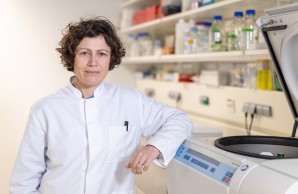


“You are what you eat”
At Yale, Prof. Bosurgi took a close interest in macrophages. “I wanted to find out whether these immune cells could do more than just remove dying cells from tissues – whether they could also actively trigger the tissue to heal itself,” she explains. Her vision: using macrophages engulfing dying cells as a form of cell therapy for chronic inflammatory diseases, such as those affecting the liver or gut. With this idea in mind, Lidia Bosurgi came to Hamburg in 2017. “It was another wonderful opportunity that I jumped at,” she says with a laugh.
Working with her research group, affiliated with UKE’s I. Department of Medicine and the Bernhard Nocht Institute for Tropical Medicine (BNITM), she achieved a major breakthrough. Prof. Bosurgi and her team discovered that macrophages can perform very different functions in the body depending on the cells they consume. “Macrophages are the big eaters of the immune system, engulfing just about everything around them – pathogens like bacteria, as well as infected or dying cells,” the scientist explains. “If they’re ‘fed’ the right ‘meal,’ they can be programmed to regenerate damaged tissue.”
She is currently studying chronic diseases that target the liver and intestines. “We think that continuous inflammation in these organs could also be treated using macrophages that have been prepared in vitro – essentially ‘fed’ in a specific way beforehand,” she says. Her team is investigating what the perfect “diet” for macrophages would be, collaborating closely with gastroenterologists at UKE and colleagues at the BNITM. Her ultimate goal? To see the first therapies with “eating” macrophages reach clinical practice within the next decade.
A Touch of Italy
Although the sun-loving southern Italian sometimes struggles with Hamburg’s climate, she feels right at home in the city. “My two children, born here, see themselves as true Hamburgers, are passionate St. Pauli fans, and wouldn’t tolerate a bad word about the German national football team,” she says with a smile. Along with the language, she’s also passed on a love of good Italian food. “Whenever we make lasagna, the kids are quick to invite a few friends over.”
She’s also brought a touch of Italy to Campus Research II. “Of course we have a good espresso machine,” she says with a wink. “I’m a total coffee lover and can be found at the machine several times a day.” It has to be strong and black – because in Italy, cappuccino and latte macchiato are only served at breakfast.