



Replace, Reduce, Refine – the 3R Principle
The aim of the 3R Principle: Replace, Reduce, Refine is to develop alternative research methods in order to eliminate animal testing as far as possible. The 3R Principle was developed by British zoologist William Russel and microbiologist Rex Burch. In 1959, the two scientists formulated the requirements of ‘Replacement, Reduction, Refinement’ in their book ‘The Principles of Humane Experimental Technique’.
This principle was legally recognised in 2010 by European Directive 2010/63/EU on the protection of animals used for scientific purposes . With the 2013 amendment to the Animal Welfare Act and the Animal Welfare Laboratory Animal Ordinance, the provisions of the European Directive and thus also the 3R Principle were incorporated into German law.
Replacement: Replacing animal testing
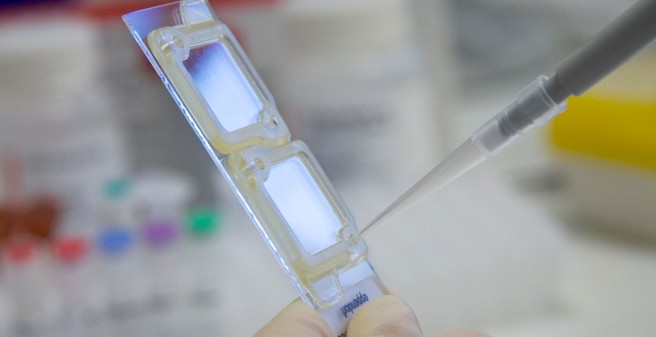
In order to eliminate animal testing altogether, other methods are used wherever possible in all research. These include, for example, in-vitro test systems such as organ-on-chip technology. In this method, tiny structures of human organs are placed in a plastic chip in a controlled microenvironment, thereby replicating the basic function of the human organ in the laboratory. Such systems can be used to replicate and control cellular processes in the body without having to conduct animal testing.
Examples of new research approaches that aim to replace animal testing can be found under 3R Research .
Reduction: Minimize animal testing
While the development and dissemination of alternative research methods has already made it possible to replace some animal testing, in other areas it may still be indispensable. If it is not possible to replace animal testing with an alternative method, the number of animal tests carried out and the number of animals used in the tests should be minimized to an unavoidable level.
Refinement: Improving methods
Scientific methods and measurement procedures used in animal experiments should be optimised. Animal models should be carefully selected and contribute to the avoidance and alleviation of pain and anxiety through species-appropriate husbandry of the experimental animals. The use of painkillers and anaesthetics in experiments reduces the stress, pain and suffering of the animals to an unavoidable minimum and maintains their well-being and quality of life at the highest possible level.