




News from "Molecular Virology of Emerging Viruses"
- Publications
- Outreach and Science Communication
- Scientific Engagement
- Awards
-
Publications
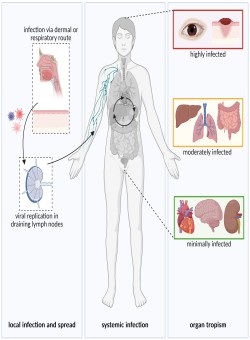
From skin lesions to multi-organ involvement: Organ tropism and pathogenesis of mpox virus
Mpox virus (MPXV), the causative agent of mpox, is a re-emerging zoonotic orthopoxvirus. Until 2022, infections were largely confined to endemic regions in Central and West Africa. However, following phylogenetic divergence and a subsequent global outbreak in 2022 caused by clade IIb, distinct from the clade I-driven resurgence in the Democratic Republic of the Congo in 2024, MPXV has emerged as a significant global health concern. While mpox is primarily characterized by its distinctive skin lesions, growing clinical and experimental evidence suggests that MPXV can replicate and disseminate to further organ systems, potentially contributing to disease severity. Despite this growing knowledge, the mechanisms underlying MPXV organ tropism and pathogenesis remain poorly understood, posing ongoing challenges for research and clinical management. This review summarizes the latest clinical, pathological, and experimental findings to provide an updated understanding of MPXV tropism and pathogenesis.
Review on MPXV tropism by Rupp et al. 2025
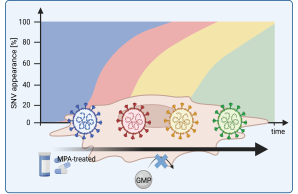

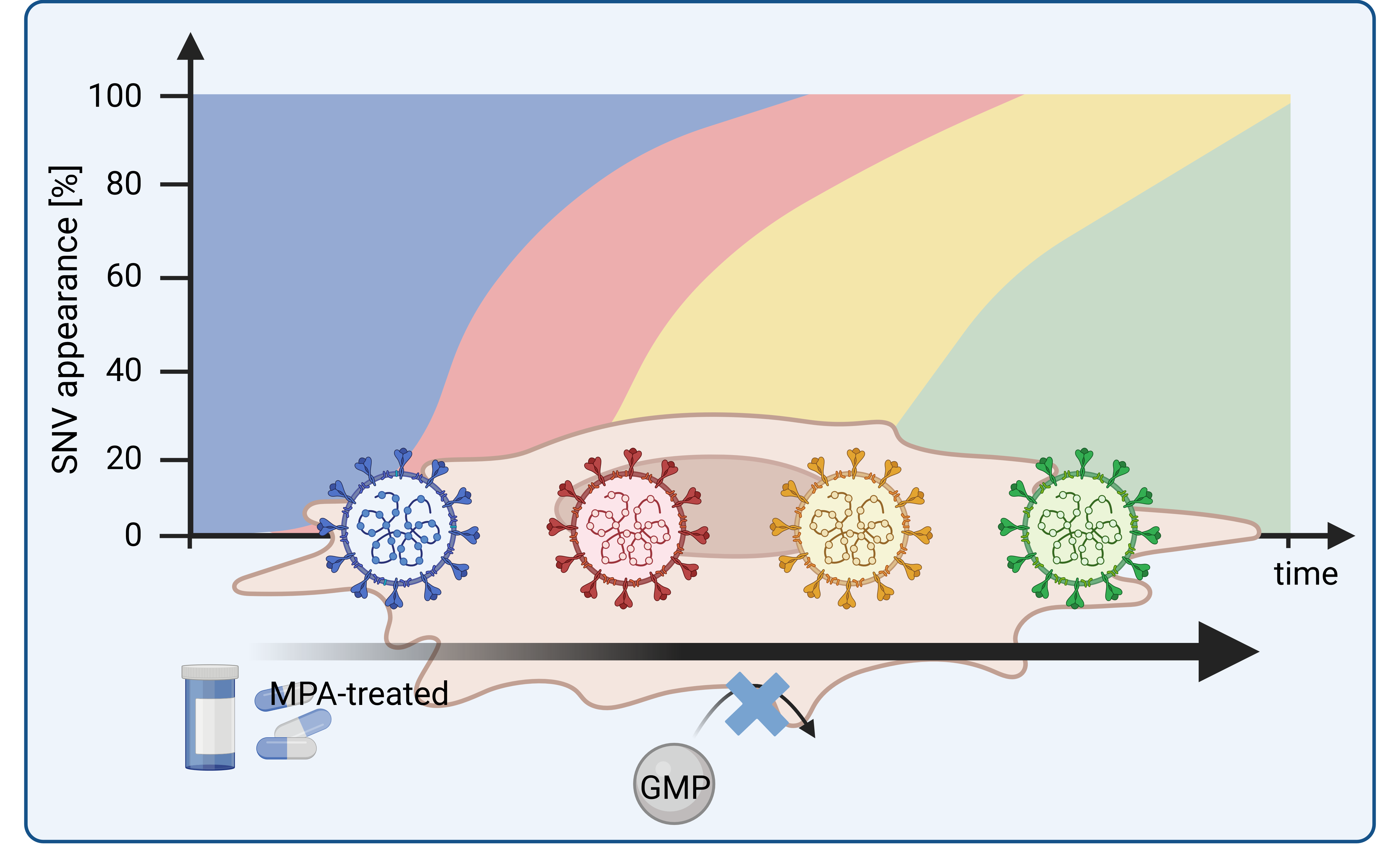
Mycophenolic acid treatment drives the emergence of novel SARS-CoV-2 variants
Mycophenolic acid (MPA) is commonly used in immunosuppressive regimens following solid organ transplantation. We demonstrate that MPA treatment reproducibly inhibits the replication of a range of viruses, including severe respiratory syndrome coronavirus 2 (SARS-CoV-2). Mechanistically, we identified cellular guanosine triphosphate pool depletion as a key mediator of this antiviral effect. Strikingly, this inhibition can be overcome which was correlated with the emergence of three breakthrough mutations in the SARS-CoV-2 genome (S P812R, ORF3 Q185H, and E S6L). Subsequent analyses confirmed that the combination of these mutations conferred accelerated replication kinetics, higher viral titers, and more rapid onset of cytopathic effects, but not MPA resistance. Comparison of global transcriptional responses to infection highlighted dysregulation of specific cellular gene programs under MPA treatment prior to breakthrough mutation emergence. Together, these findings identify viral and host drivers of variant emergence under immunosuppression. They also advocate for close monitoring of immunosuppressed patients, where emergence of novel viral variants with a fitness advantage may arise.
Paper on SARS-CoV-2 evolution under immunosuppression by Meister et al. 2025
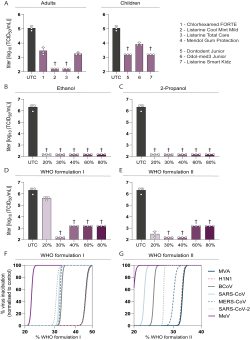
Susceptibility of Measles Virus to World Health Organization–Recommended Hand Rubs, Oral Rinses, and Surface Disinfectants
Measles continues to pose a major public health threat worldwide. Reoccurring outbreaks are fueled by declining vaccination rates, increased global travel, migration, and disruptions in immunization programs. Consequently, hygiene measures remain essential to prevent transmission, particularly in health care settings where nosocomial infections can occur.
To address this, we tested virus inactivation by common oral rinses, as primary transmission occurs via aerosols and droplets, using a quantitative suspension assay in accordance with European guidelines. We further evaluated World Health Organization–recommended hand rub formulations based on ethanol and 2-propanol with the same assay. After confirming that measles virus remains viable for several hours on stainless steel, we assessed the efficacy of surface disinfectants, including alcohol-, aldehyde-, and hydrogen peroxide–based products.
The virus was effectively inactivated by World Health Organization–recommended hand rub formulations, oral rinses, and surface disinfectants, demonstrating the effectiveness of standard hygiene measures in infection control. These findings underscore the critical importance of consistent hygiene practices in limiting measles transmission.Paper on disinfection of Measles virus by Sandoval Flores et al. 2025
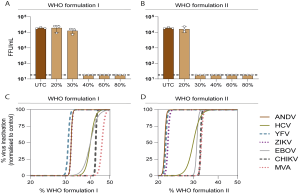
Stability of Andes virus and its inactivation by WHO-recommended hand-rub formulations and surface disinfectants
Hantaviruses are responsible for thousands of infections globally. In the absence of vaccines or targeted treatments for severe diseases such as haemorrhagic fever with renal syndrome and hantavirus cardiopulmonary syndrome, medical care focuses solely on managing symptoms. As a result, preventive hygiene measures, such as disinfection, are essential to reduce transmission and minimize the virus's impact on human health. The aim of this study was to assess the effectiveness of commonly used disinfectants in inactivating Andes virus (ANDV) and evaluate the virus's stabilty to support evidence-based hygiene strategies. The virucidal activity of hand antiseptics against ANDV was assessed using a quantitative suspension test in accordance with the European guideline EN14476. Surface disinfection efficacy was evaluated according to EN16777 and virus stability was assessed on stainless steel.
These findings indicate that ANDV has lower environmental stability compared to other enveloped viruses and can be effectively inactivated by all disinfectants tested. This data can inform risk assessments, especially in areas where hantavirus outbreaks are common, and may guide cleaning protocols for both healthcare environments and high-risk public spaces.Paper on disinfection of Hantaviruses by Nilsson-Payant et al. 2025
-


-
Outreach and Science Communication

Rahel Liebeschütz-Plaut Mentoring Program for Clinicians and Postdoctoral Researchers
PD Dr. Toni L. Meister was part of the 7th cohort that celebrated their graduation at the Erika House of UKE after 2 years of interesting workshops and networking.
June 2026
Get more information about the program here

LinkedIn Post of Universitätsklinikum Hamburg Eppendorf
A Look Inside the Lab!
Dr. Toni L. Meister is a junior research group leader at the Institute of Infection Research and Vaccine Development (IIRVD) at UKE Hamburg and a member of Collaborative Research Center (CRC) 1648. Together with her team, she studies emerging pathogens, with a particular focus on SARS-CoV-2, MPXV, and RSV. Their research investigates virus–host interactions and the potential impact of these pathogens on the general population.
Her work follows a translational research approach, meaning that findings from basic research are ultimately intended to be translated into clinical practice, where they can directly benefit patients.September 2025
Find the post Link
Infect-Net – Association of German Women Infection Researchers
An Interview for Infect-Net TV
Role Models Show Me: I Can Do It Too!February 2025
Watch the full video here
Get more information about Infect-Net here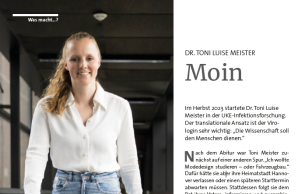
UKE Magazine Life - Summer/Fall 2024
An Interview with UKE Moin
Since autumn 2023, Dr. Toni L. Meister has been part of the Institute for Infection Research and Vaccine DepvelopmentSeptember 2024
Find the article here

SYNERGIE – Forschen für Gesundheit
Das Magazin der Deutschen Zentren der Gesundheitsforschung (DZG)Newcomer im Porträt - Ein Interview mit dem DZG Maganzin Synergie
April 2024
Find the article here
-
-
Scientific Engagement

Co-Speaker of the young Society of Virology and its Young PI working group
Recently, PD. Dr. Toni L. Meister joined the steering committe of the Young PI faculty and was elected co-speaker of the working group established within the framework of the young society of virology (jGfV).
She later joined the board of the jGfV as a co-speaker.May 2026
Get more information about the yGfV here

New member of the steering committee in the DZIF-Academy
Earlier this year PD Dr. Toni L. Meister joined the DZIF Academy as a new member of the steering committee.
February 2026
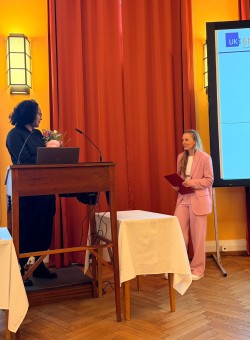

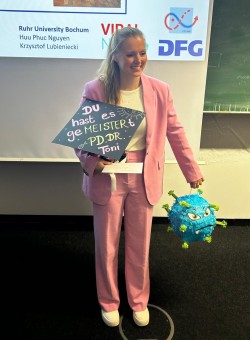
Habilitation of Toni L. Meister
We are very happy to congratulate Toni L. Meister on her successful habilitation at the IIRVD.
In her habilitation thesis, “Prevention Strategies of Emerging Viruses in the Era of Vaccines and Direct-Acting Antivirals,” she explores new and innovative approaches to preventing emerging viral infections, combining insights from vaccine development and antiviral therapies.
Toni L. Meister has made a significant contribution to the field and has been an important part of the IIRVD. We especially appreciate her dedication, expertise, and the great collaboration over the past years.
Congratulations again, Toni — we’re looking forward to what’s next!
March 2026

New Member of the Scientific Advisory Board at Dr. Brill Institutes
Dr. Brill Institute welcomed PD Dr. Toni L. Meister to their scientific advisory board as of June 2026
January 2026
Find the article here
-
-
Awards

Toni L. Meister received the award „Clinical Virology“ from the German Association for the Control of Viral Diseases (DVV) and the German Society of Virology (GfV)
This award honors outstanding scientific contributions that provide important new insights in the field of clinical virology while addressing key aspects of public health and infectious disease prevention.
September 2025
Get more information about the award here (DVV)
Get more information about the award here (GfV) -