


P21 - Pelvic Rosetta Classification
Daniel Koehler & Alexander Schlaefer & Tobias Maurer
Department of Diagnostic and Interventional Radiology and Nuclear Medicine
Institute of Medical Technology and Intelligent Systems at the Hamburg University of Technology
Martini-Klinik at the University Medical Center Hamburg-Eppendorf
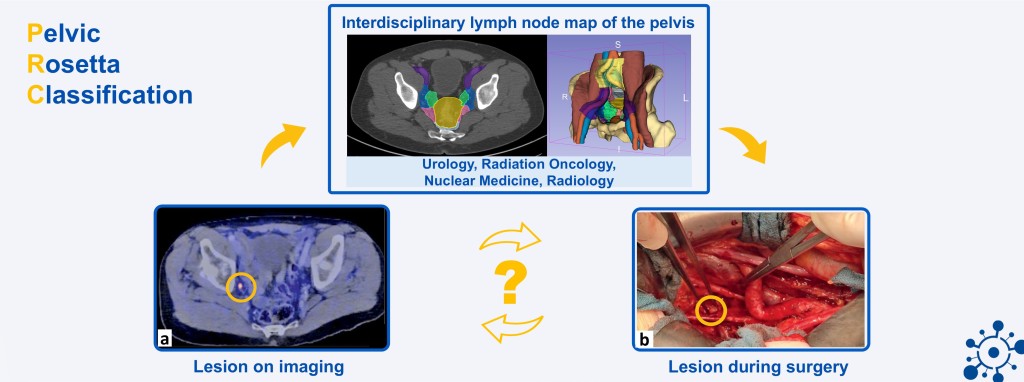
Prostate cancer (PCa) frequently metastasizes to the pelvic lymph nodes with highly variable patterns of spread. Advanced imaging modalities like prostate-specific membrane antigen positron emission tomography depict metastases with significantly improved sensitivity compared to conventional methods, enabling more accurate therapies in all disease stages. However, extended pelvic lymph node dissection remains the gold standard for the detection of lymph nodes metastases in PCa. Although proposed surgical templates exist, considerable heterogeneity between centers and surgeons remains, complicating the comparison of treatment strategies and oncologic outcomes. The aim of the Pelvic Rosetta Classification (PRC) project was to create an interdisciplinary, landmark-based map of pelvic lymph node areas (LNAs) in PCa to enhance communication between medical specialists, advance standardization, and consequently improve patient care.
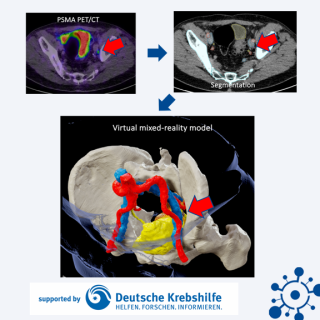
Pelvic LNAs were defined in a consensus-driven, multi-stage development process involving 19 experts from urology, radiation oncology, nuclear medicine, and radiology. Key anatomic landmarks such as vessels, organs, bones, and muscles that are readily identifiable on imaging and during surgery served as borders of LNAs to ensure reproducibility. Evaluation rounds between consensus meetings were implemented to validate definitions by contouring LNAs on contrast-enhanced computed tomography slices of the pelvis and assign target lymph nodes to specific LNAs. Results of the evaluation rounds were reviewed during online consensus meetings and border definitions were adapted if necessary. LNAs without clear landmarks on cross-sectional imaging demonstrated the highest variability between experts. To reduce inconsistencies in the interpretation of target lymph node metastasis locations, guidance statements for the delineation of LNAs were also included in the Pelvic Rosetta Classification. In total, eight pelvic and four extrapelvic LNAs were ratified by the experts and a corresponding 3D-model was created for better visualization.
The Pelvic Rosetta Classification is a first step towards standardized assessment of locoregional lymph node metastases in PCa. Next, its utility in daily practice and clinical relevance have to be validated in future trials. The Pelvic Rosetta Classification is a living project intended to improve interdisciplinary communication and consequently patient care.
Grants: ---
Contact: d.koehler@uke.de
-
Selected publications on topic
The Pelvic Rosetta Classification Project: An Interdisciplinary Proposal for a Lymph Node Map of the Pelvis in Prostate Cancer. Ortner G, Hoderlein X, Barbato F, Beyersdorff D, Budäus L, Burger IA, Eiber M, Graefen M, Hadaschik B, Haese A, Herrmann K, Maack L, Maric I, Mattei A, Rauscher I, Salomon G, Sauer M, Schimmöller L, Schlaefer A, Schlemmer HP, Spohn SKB, Umutlu L, Walz J, Würnschimmel C, Koehler D, Maurer T. J Nucl Med. 2026 Jan 2;67(1):154-159. doi: 10.2967/jnumed.125.270667.
