


P20 - NICE-PSMA: Navigation, Outcomes, and Quality of Life in Prostate Cancer Patients undergoing PSMA-targeted Surgery
Tobias Maurer & Daniel Koehler & Alexander Schlaefer
Martini-Klinik at the University Medical Center Hamburg-Eppendorf
Department of Diagnostic and Interventional Radiology and Nuclear Medicine
,
Institute of Medical Technology and Intelligent Systems at the Hamburg University of Technology
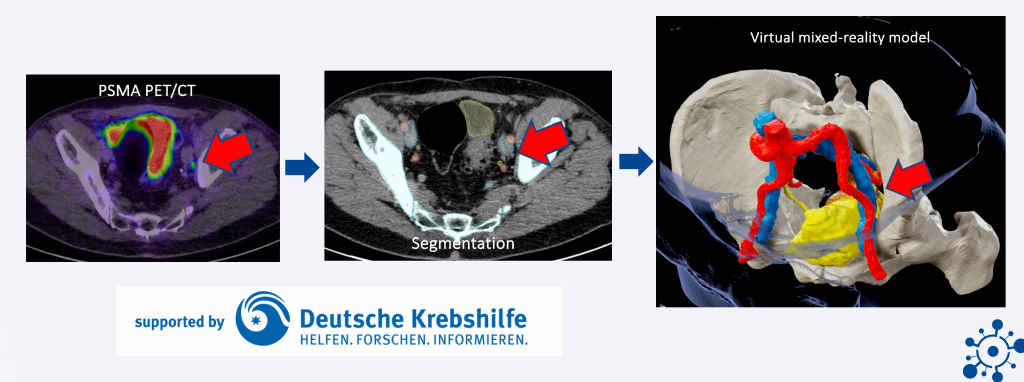
Modern PSMA PET imaging enables the detection of even small lymph node metastases in patients with prostate cancer. When lymph node spread is present, treatment typically involves either combined radiotherapy and hormone therapy or surgery. However, surgical detection and removal of small or atypically located metastases remains challenging.
The prospective NICE-PSMA study (NCT07129551; DRKS00037627) explores the feasibility and added value of using virtual 3D mixed-reality models to improve surgical planning and intraoperative navigation in patients undergoing lymph node dissection for PSMA PET-positive lesions. This model is derived from preoperative imaging and is evaluated by surgeons, surgical teams, and patients as a tool for orientation, education, and decision-making.
The study compares standard surgical outcomes with those supported by 3D models, examining not only the completeness of tumor removal but also the impact of 3D guidance on surgical efficiency and instrument movement during robot-assisted procedures. Additionally, the team is developing two navigation techniques (landmark-based registration and visual tracking) to enhance intraoperative localization. Short-term oncological outcomes, such as PSA response rates, and patient-reported quality of life are also key endpoints.
We expect this approach to support more accurate surgery, potentially improving clinical outcomes and reducing the need for systemic therapy. Furthermore, the 3D models may serve as valuable communication tools within the surgical team and in patient education. Insights gained could also benefit surgical strategies for other cancers requiring targeted interventions.
Grants: Deutsche Krebshilfe
Contact: d.koehler@uke.de
-
Selected publications on topic
- - -
