 UKE homepage?
 DE
DE
Humanized mice to study the zoonotic potential and pathophysiology of hepatotropic emerging pathogens
Summary
Many viruses that cause disease in humans – such as SARS-CoV-2 or Ebola – cannot be effectively studied in standard laboratory mice. Either the viruses don't infect mice at all, or the infection doesn’t resemble human disease. To address this, researchers use humanized mice—genetically modified animals with human cells in specific organs, such as the liver or immune system.
These models allow scientists to study how viruses interact with human cells in a living organism. The human liver is especially important, as it is involved in infections by a wide range of viruses – not only classic hepatitis viruses, but also viruses like Ebola, Dengue, or Yellow Fever. Moreover, some animal viruses closely related to human hepatitis viruses have been shown to infect human liver cells in the lab, raising concerns about their potential to jump to humans.
This project aims to understand how emerging and neglected viruses interact with the human liver, how they cause disease, and whether they pose a risk to humans. Using and improving humanized and chimeric mouse models, the project will help assess the potential danger of such viruses and support the development of better diagnostics and treatments.
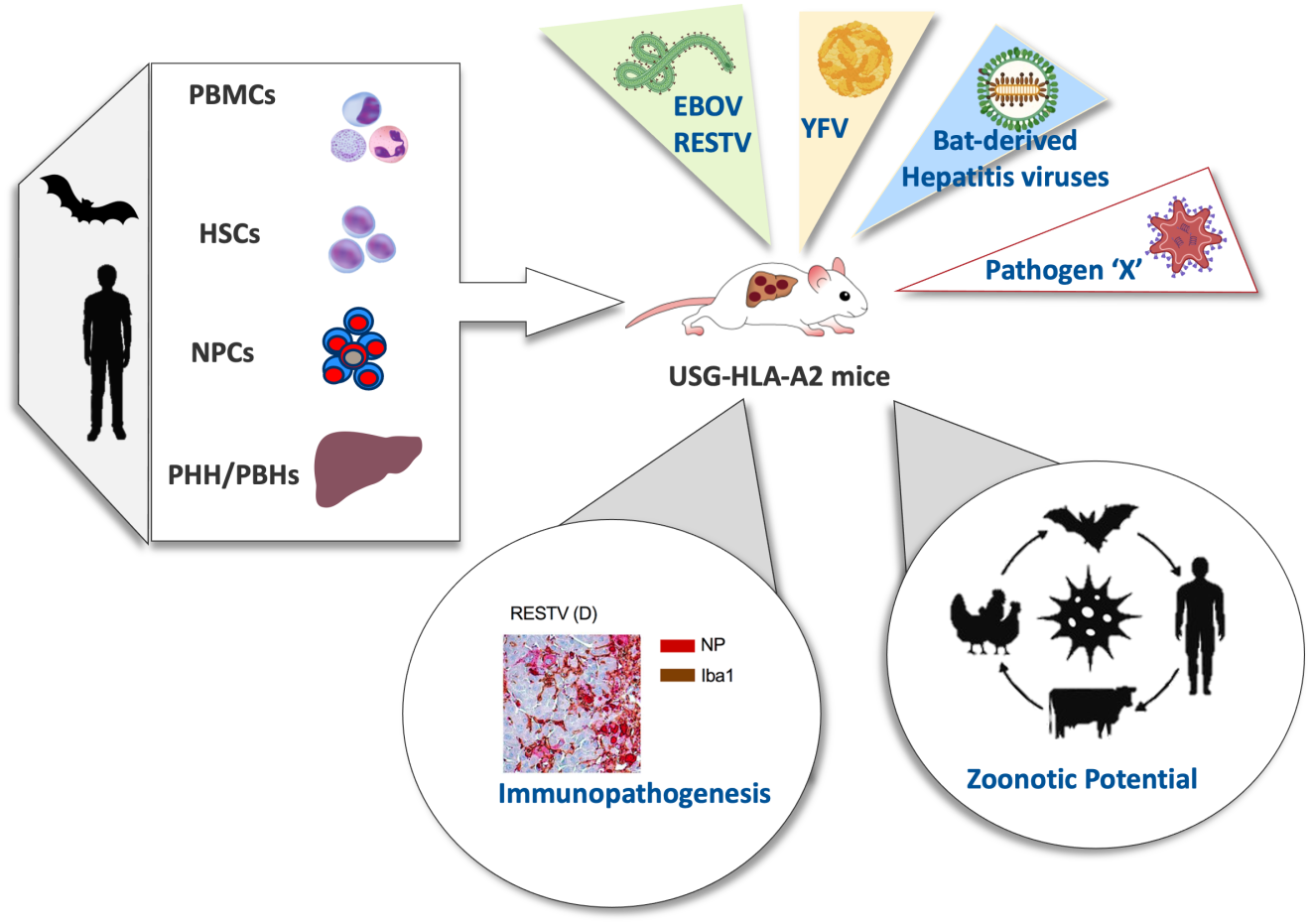
Our Work Packages (WP):
WP1: Generation of dually reconstituted chimeric mice.
WP2: In vivo assessment of the zoonotic potential and pathogenecity of hepatitis viruses isolated from wild animals in humanized mice.
WP3: To study virus-host interactions and pathogenicity of bad-derived emerging and hepatitis viruses in bat-chimeric mice.
Main goal ist to evaluate the zoonotic potential, hepatotrophism and pathophysiology of distinct emerging viruses using humanized and new chimeric mouse models.
Team


Prof. Dr. Maura Dandri
Principal Investigator
E-mail address:
Phone: +49 (0) 40 7410 - 52949


Dr. Estefania Rodríguez
Principal Investigator
E-mail address:
Phone: +49 40 285380 541


Research Group Dandri
The Research Group Virus Hepatitis is based at the University Medical Center Hamburg-Eppendorf (UKE).
Research Group Rodríguez
The Research Group Preclinical Models is based at the Bernhard Nocht Institute for Tropical Medicine (BNITM).
Project related publications
Bodmer BS, Breithaupt A, Heung M, ..., Rodríguez E, ..., Muñoz-Fontela C, Hoenen T, Escudero-Pérez B. In vivo characterization of the novel ebolavirus Bombali virus suggests a low pathogenic potential for humans. Emerg Microbes Infect. 2023;12(1):2164216. doi: 10.1080/22221751.2022.2164216.
Allweiss L, Giersch K, Pirosu A, …, Fletcher SP, Lütgehetmann M, Dandri M. Therapeutic shutdown of HBV transcripts promotes reappearance of the SMC5/6 complex and silencing of the viral genome in vivo. Gut. 2022;71:372-381.
Rottstegge M, Tipton T, Oestereich L, ... Rodríguez E, …, Günther S, Carroll MW, Muñoz-Fontela C. Avatar Mice Underscore the Role of the T Cell-Dendritic Cell Crosstalk in Ebola Virus Disease and Reveal Mechanisms of Protection in Survivors. J Virol. 2022;96(18):e0057422. doi: 10.1128/jvi.00574-22.
Wisskirchen K, Kah J., Malo A …, Bauer T, Dandri M#, Protzer U#. T cell receptor grafting allows virological control of hepatitis B virus infection. J Clin Invest. 2019;129:2932-45.
Escudero-Pérez B, Ruibal P, Rottstegge M, ..., Krasemann S, Rodríguez E#, Muñoz-Fontela C#. Comparative pathogenesis of Ebola virus and Reston virus infection in humanized mice. JCI Insight. 2019;4(21):e126070. doi: 10.1172/jci.insight.126070.
Giersch K, Bhadra OD, Volz T, …, Riecken K, Fehse B, Lohse AW, …, Urban S, Dandri M#, Lütgehetmann M#. Hepatitis delta virus persists during liver regeneration and is amplified through cell division both in vitro and in vivo. Gut. 2019 Jan;68(1):150-157.
Kah J, Koh S, Volz T, …, Lütgehetmann M, Bertoletti A, Dandri M. Lymphocytes transiently expressing virus-specific T cell receptors reduce hepatitis B virus infection. J Clin Invest. 2017;127:3177-88.
Rodríguez E, Ip WH, Kolbe V, ..., Muñoz-Fontela C, Krasemann S, Dobner T. Humanized Mice Reproduce Acute and Persistent Human Adenovirus Infection. J Infect Dis. 2017;215(1):70-79. doi: 10.1093/infdis/jiw499.
Petersen J#, Dandri M#, Mier W, …, Erbes B, Seitz S, Urban S. Prevention of hepatitis B virus infection in vivo by entry inhibitors derived from the large envelope protein. Nat Biotechnol. 2008;26:335-41.
#equally contributing authors