 UKE homepage?
 DE
DE

Targeting cellular and viral enzymes involved in hemorrhagic fever virus replication using new small molecule broad spectrum inhibitors
Summary
This project focuses on developing two types of antiviral treatments. The first aim is to create small molecule inhibitors targeting the host enzyme dihydroorotate dehydrogenase (DHODH), which is essential for viral genome replication and transcription. DHODH plays a key role in pyrimidine synthesis, crucial for viral replication. We recently identified a promising inhibitor through high-throughput screening, but it was too toxic for use. We will now develop new, less toxic inhibitors using structure-based drug design techniques, including X-ray crystal structure analysis and cryo-EM to enhance antiviral potency and therapeutic index.
The second aim focuses on designing nucleoside analogue triphosphates (NTPs) to inhibit RNA-dependent RNA polymerases (RdRp), which are vital for the replication of various hemorrhagic fever viruses. We will chemically synthesize new NTPs and use viral RNA-polymerase assays to test their effectiveness. Since NTPs are polar and cannot pass through cell membranes, we will apply "chemical-horse-pronucleotide" strategies to ensure their intracellular delivery. By targeting both DHODH and RdRp, we hypothesize that a combined approach will provide a synergistic effect, blocking two essential viral replication processes and potentially reducing the development of resistant viruses.
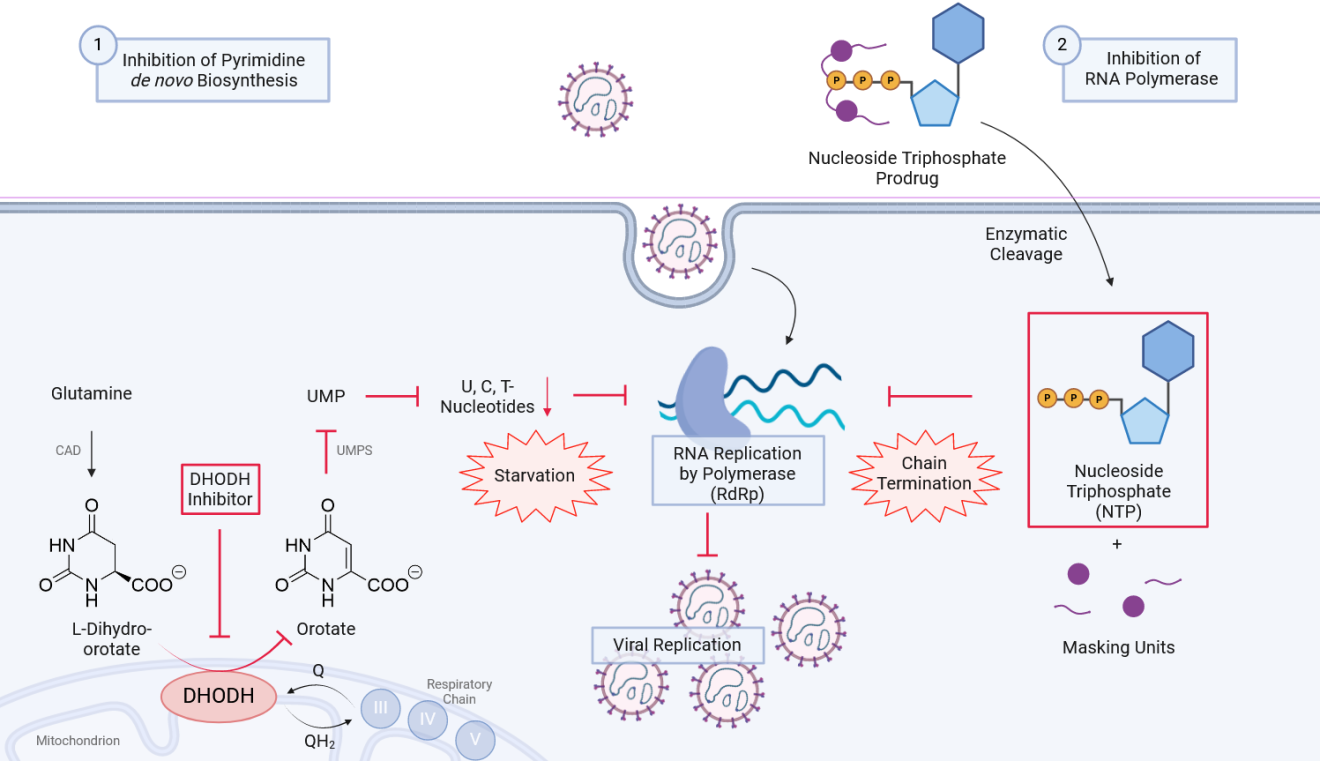
Our Work Packages (WP):
WP1: Chemical Synthesis of Small Molecule Inhibitors Targeting DHODH
We investigate the development of small molecule inhibitors targeting the host enzyme DHODH to disrupt pyrimidine biosynthesis and suppress viral replication.
WP2: Synthesis of NTPs as Inhibitors of Viral RNA-Dependent RNA Polymerases
We investigate the design and synthesis of nucleoside triphosphates (NTPs) to inhibit the RNA polymerases of hemorrhagic fever viruses, aiming to block viral replication at the enzymatic level.
With these work packages, we aim to develop novel antiviral strategies targeting both host and viral factors essential for viral replication, offering a broad-spectrum approach to combating hemorrhagic fever viruses.
Team


Prof. Dr. Chris Meier
Principal Investigator
E-mail address:
Phone: +49 40 42838-4324



Research Group Meier
The Research Group Synthetic Organic Chemistry, Medicinal Chemistry and Chemical Biology is based at the University of Hamburg.
Project related publications
Kouba T, Dubankova A, Drncova P, Donati E, Vidossich P, Speranzini V, Pflug A, Huchting J, Meier C, de Vivo M, Cusack S. Direct Observation of Backtracking by Influenza A and B Polymerases upon consecutive Incorporation of the Nucleoside Analog T1106. Cell Rep 2023;42:111901. doi: org/10.1016/j.celrep.2022.111901.
Jia X, Schols D, Meier C. Lipophilic Triphosphate Prodrugs of various Nucleoside Analogues. J Med Chem 2020;63:6991-7007. doi: org/10.1021/acs.jmedchem.0c00358.
Jia X, Schols D, Meier C. Anti-HIV-active Nucleoside Triphosphate Prodrugs. J Med Chem 2020;63:6003-6027. doi: org/10.1021/acs.jmedchem.0c00271.
Shannon A, …. Meier C, … Canard B. Rapid Incorporation of Favipiravir by the fast and permissive viral RNA Polymerase Complex results in SARS-CoV-2 lethal Mutagenesis. Nat Commun 2020;11:4682. doi: org/10.1038/s41467-020-18463-z.
Zhao C, Weber S, Schols D, Balzarini J, Meier C. Prodrugs of gamma-Alkyl-modified Nucleoside Triphosphates - improved Inhibition of HIV Reverse Transcriptase. Angew Chem Int Ed 2020;59:22063-22071. doi: org/10.1002/anie.202003073.
Huchting J, Vanderlinden E, Winkler M, Nasser H, Naesens L, Meier C. Prodrugs of the Phosphoribosylated Forms of Hydroxypyrazinecarboxamide Pseudobase T-705 and its De-Fluoro-Analogue T-1105 as Potent Influenza Virus Inhibitors. J Med Chem 2018;61:6193-6210. doi: org/10.1021/acs.jmedchem.8b00617.
Gollnest T, Dinis de Oliveira T, Rath AK, Hauber I, Schols D, Balzarini J, Meier C. Membrane-permeable triphosphate prodrugs of nucleoside analogues. Angew Chem Int Ed 2016;55:5255-5258. doi: org/10.1002/anie.201511808.
Gollnest T, Dinis de Oliveira T, Schols D, Balzarini J, Meier C. Lipophilic Prodrugs of Nucleoside Triphosphates as biochemical Probes and potential Antivirals. Nat Commun 2015;6:8716. doi: org/10.1038/ncomms9716.
Jessen HJ, Schulz T, Balzarini J, Meier C. Bioreversible Protection of Nucleoside Diphosphates. Angew Chem Int Ed 2008;47:8719-8722. doi: org/10.1002/anie.200803100.
Meier C. cycloSal Phosphates as chemical Trojan Horses for intracellular Nucleotide and Glycosyl-monophosphate Delivery - Chemistry meets Biology. Eur J Org Chem 2006. doi: org/10.1002/ejoc.200500671.
#equally contributing authors